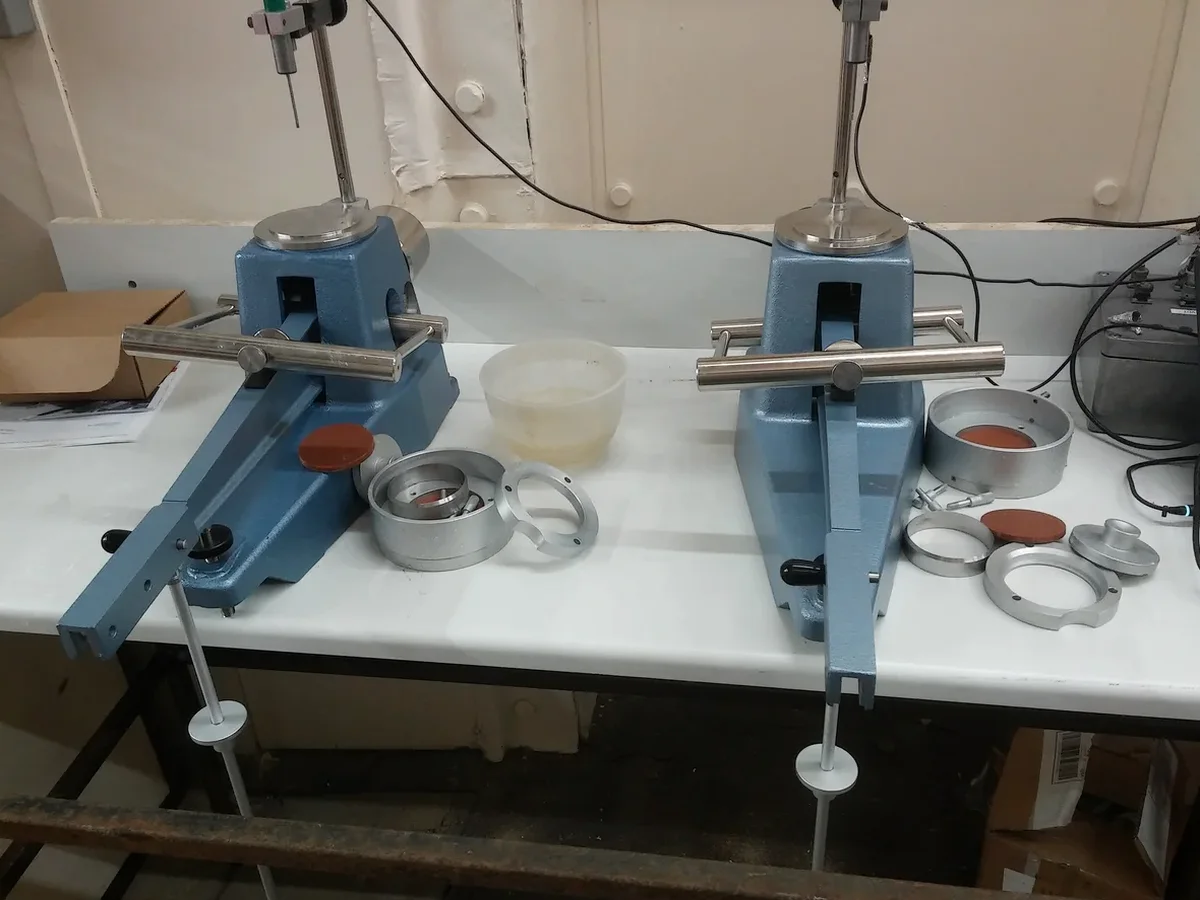
The difference between building on the upland till near Burke Mountain and the softer soils closer to the Fraser River is stark. One site yields a firm, gravelly matrix that drains quickly; the other holds moisture and changes volume with every wet season. Atterberg limits testing quantifies that behavioral gap. By measuring the liquid limit, plastic limit, and plasticity index of fine-grained soils, the team identifies exactly how a Coquitlam soil will respond to water content changes. For contractors working near Como Lake or along the Barnet Highway corridor, that data turns soil uncertainty into a manageable design parameter. In many cases, grain-size analysis provides the complementary particle distribution needed to classify the full soil profile under the Unified Soil Classification System.
A plasticity index above 15 in Coquitlam's glacial lake sediments signals that seasonal moisture cycling will influence foundation performance.
Methodology and scope
Much of Coquitlam sits on a complex stratigraphy of Vashon glacial till overlying advance outwash and, in lower areas, glaciomarine stony clay. The till itself is typically a dense, silty sand with low plasticity, but lenses of laminated silt and clay appear unpredictably, particularly in the Maillardville and Fraser Mills redevelopment zones. Atterberg limits testing under ASTM D4318-17e1 separates truly plastic clays from non-plastic silts that might be mistaken for clay during field logging. The laboratory procedure involves the Casagrande cup device for liquid limit determination and the rolling-thread method for plastic limit, both performed on material passing the No. 40 sieve. When the plasticity index exceeds 15, the soil warrants careful shrink-swell evaluation before foundation grade is set. Coquitlam's average annual precipitation of roughly 1,900 mm, concentrated between October and April, creates seasonal moisture cycles that expose even moderate-plasticity soils to volume change risk over time.
Local considerations
The transformation of Coquitlam from a mill town into a dense suburban node reshaped the ground beneath it. Fraser Mills, once the largest lumber mill in the British Empire, left behind fill and organic silts that now underpin modern mixed-use projects. Foundation distress in these zones often traces back to fine-grained soils with a liquidity index near or above 1.0, a condition where the soil behaves more like a viscous fluid than a solid when remolded. Atterberg limits testing identifies this sensitivity before excavation begins. Even on the slopes of Westwood Plateau, where glacial till dominates, thin interbeds of laminated silt can develop perched water tables that soften the material over time. Quantifying the plasticity index allows geotechnical engineers to assign appropriate bearing capacity reduction factors and to specify lime or cement stabilization where the native soil falls outside the acceptable range for structural fill.