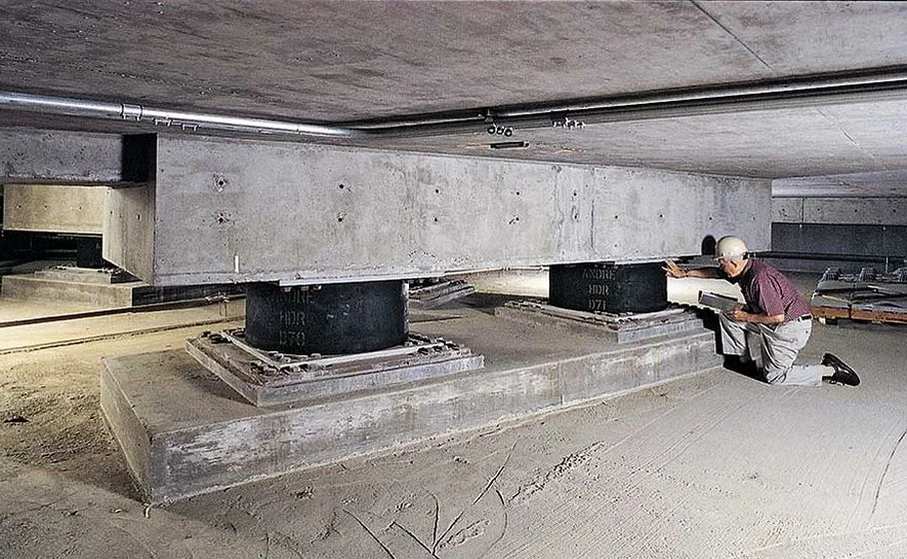
Coquitlam sits at the confluence of the Fraser and Pitt Rivers, where the deep post-glacial sediments amplify seismic waves in ways that standard fixed-base buildings cannot always handle. The city's population has grown 10% since 2016, pushing new critical infrastructure onto the soft alluvial deposits of the Maillardville and Fraser Mills areas. In our practice, we have seen how a well-designed base isolation system decouples a structure from the worst ground accelerations—reducing inter-story drift by up to 60% compared to a conventional design. The 2020 NBCC classifies much of the Lower Mainland as having a Site Class C to E, depending on the proximity to the river channels, which makes the seismic microzonation data from the City of Coquitlam's own studies essential before even selecting an isolator type. When a client brings us a project near the Lafarge Lake area or the new Burke Mountain developments, we start by correlating the site-specific shear wave velocity with the expected displacement demand on the isolation plane.
An isolation system is only as good as its displacement compatibility with the soil—on Coquitlam's soft clays, a 40 cm lateral demand can become 65 cm if the basin effects are not modeled correctly.