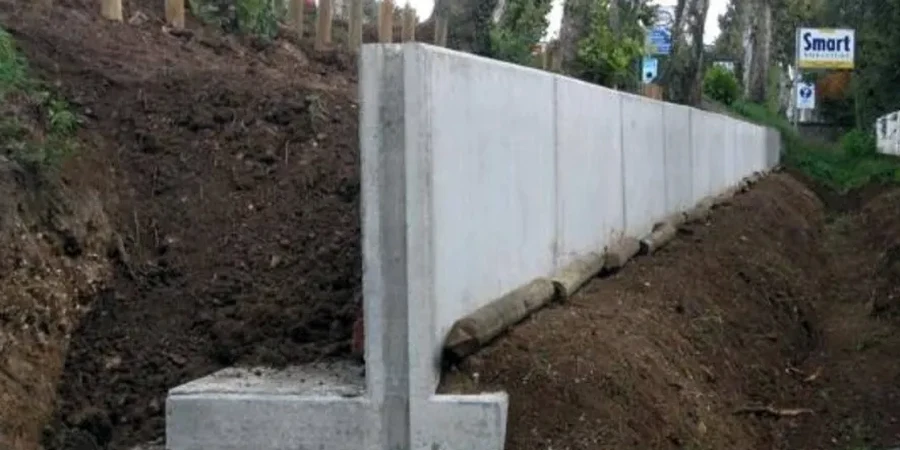
Too many retaining walls in Coquitlam get designed from a desk using assumed soil parameters that have nothing to do with what is actually buried under the site. A wall on Burke Mountain behaves nothing like one near the Coquitlam River flats, and when you skip the site-specific investigation, you are gambling with differential fill settlement, perched groundwater, and a failure that shows up two winters later. We have seen it. The fix starts with a design methodology that ties retaining wall geometry directly to the subsurface profile — not a generic table from a textbook. For taller walls on sloping backfill, integrating slope stability analysis early in the design phase prevents the kind of global instability that a cantilever section alone cannot address.
A Coquitlam retaining wall without a drainage design is a liability with a fuse — and the fuse is the first heavy November rain.
Local considerations
NBCC 2020 assigns most of Coquitlam to Seismic Design Category D, which means retaining walls over 1.2 m high must be designed for the seismic earth pressure increment using the Mononobe-Okabe method — not just static Coulomb. That is not a suggestion; it is a code requirement that gets overlooked more often than it should in single-family hillside construction. The real risk is not overturning alone. It is a compound failure: saturated backfill from an undersized drainage system, liquefied foundation soil from an uninvestigated loose layer at depth, and a seismic increment that was never modeled. Combine those three, and a wall that looks fine on a summer afternoon becomes a debris flow by Boxing Day. Coquitlam's topography amplifies the consequence — a failed wall at the top of a slope rarely stops at the property line. For walls retaining more than 2.5 m of cut, we tie the design directly to deep excavation monitoring protocols during construction, so that actual lateral movements are measured against the predicted envelope before the backfill is placed.
Applicable standards
NBCC 2020 (National Building Code of Canada) — Seismic Design Category D, soil-structure interaction provisions, CSA A23.3:2019 — Design of Concrete Structures, retaining wall provisions, FHWA-NHI-10-024 — Earth Retaining Structures, MSE wall and gravity wall design, ASTM D7181 — Consolidated Drained Triaxial Compression Test for Soils
Quick answers
What is the typical cost range for retaining wall design in Coquitlam?
Does Coquitlam require a permit and engineering stamp for a retaining wall?
Yes. The City of Coquitlam Building Bylaw requires a building permit and a Professional Engineer's sealed design for any retaining wall over 1.2 m in height measured from the bottom of the footing to the top of the wall, or any wall supporting a surcharge such as a driveway or building within the zone of influence.
What soil information do you need before starting the retaining wall design?
At minimum, we need a borehole or test pit log within the wall footprint that identifies the soil stratigraphy, groundwater level during the wet season, and SPT N-values. For walls over 2.5 m or sites near the Pitt River, we also run triaxial testing to get drained strength parameters and check for liquefiable layers.
How do you handle drainage behind the wall in Coquitlam's rainy climate?
We design the drainage system for Coquitlam's 1:50 year 24-hour rainfall intensity. This means specifying a continuous blanket drain with clean crushed rock wrapped in a non-woven geotextile filter, connected to a perforated toe drain that outlets to a positive gravity discharge. We size the weep hole spacing and diameter based on the permeability of the backfill material determined in the lab.