← Home · Laboratory

Laboratory CBR Testing in Coquitlam: Subgrade Strength for Roads and Pavements

Together, we solve the challenges of tomorrow.

LEARN MORE →

We have seen too many Coquitlam paving projects where the subgrade looked solid at first glance but failed six months later under truck traffic. The culprit is almost always the same: skipping a proper laboratory soaked CBR test on fine-grained glacial till. Coquitlam sits on a complex mix of Vashon Drift deposits, and the silty matrix can lose up to 70 percent of its bearing capacity when saturated during the rainy season. A field density reading alone will not tell you that. Our lab runs ASTM D1883-21 procedures with three-point compaction curves to give you a CBR value that reflects real post-construction moisture conditions. We pair this with grain-size analysis to confirm fines content and Atterberg limits when plasticity is suspected in the subgrade material.

A soaked CBR value below 5 percent means you are essentially building on a sponge. Coquitlam tills can drop that low after 96 hours of saturation.

Methodology and scope

A recent townhouse development off Pipeline Road in Coquitlam illustrates the challenge. The site had compacted sand and gravel fill over native till, and the consultant specified a CBR of 20 percent for the access road. During our lab prep, we compacted remolded samples at 95 percent standard Proctor and soaked them for 96 hours as per ASTM D1883. The measured soaked CBR came back at 11 percent, well below the design requirement. The fix was straightforward: over-excavate 400 mm and replace with crushed granular base, verified with a Proctor compaction test to lock in the density target. Without the soaked CBR data, that pavement would have rutted within the first winter. Our Coquitlam lab maintains a controlled soak tank at 20 degrees Celsius with continuous water level monitoring; every sample is dial-gauge tracked at 0.025-inch penetration intervals up to 0.5 inch, and we report both the 0.1-inch and 0.2-inch CBR values plus the swell percentage.
Laboratory CBR Testing in Coquitlam: Subgrade Strength for Roads and Pavements
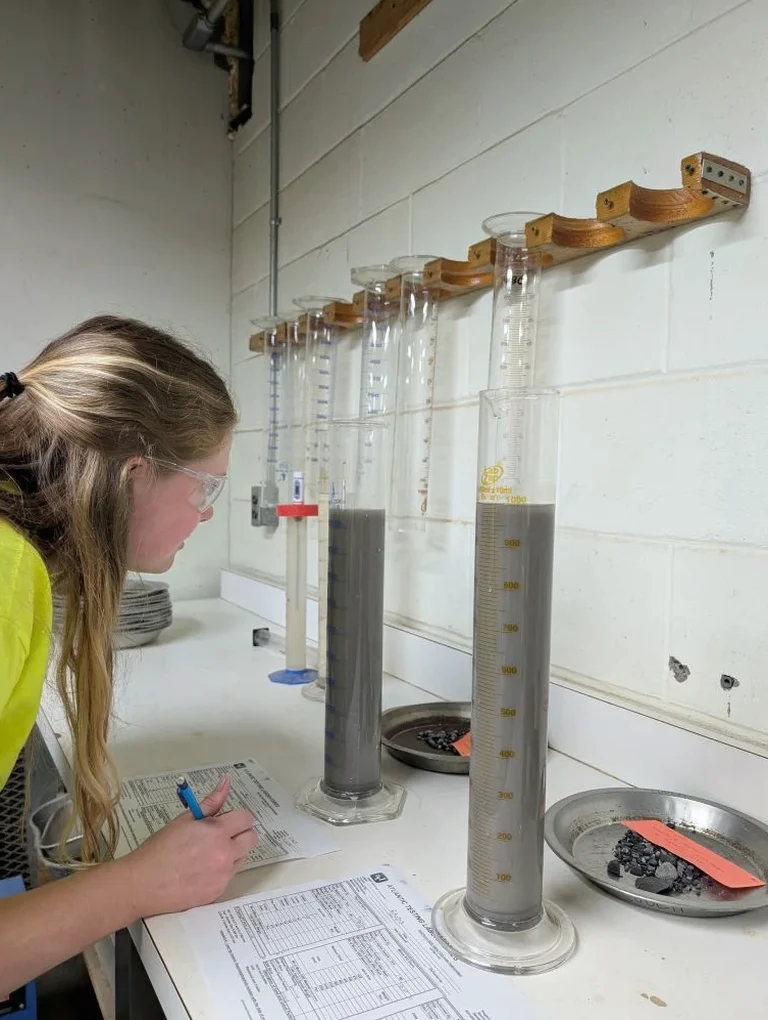
Technical reference image — Coquitlam

Local considerations

Coquitlam's geology is dominated by Vashon glaciation deposits: stony till over glaciomarine silts and clays with pockets of outwash sand. The water table across much of the lower Coquitlam River basin sits within 1.5 meters of the surface from November through March. When you compact a silty subgrade at optimum moisture in August and test it unsoaked, you might see a CBR of 25 or higher. After four days of soaking in the lab that same soil can drop to CBR 4, which is structurally useless for anything heavier than a footpath. The worst-case scenario we encounter regularly is a thin granular veneer over soft clay: the contractor sees gravel, assumes competent subgrade, and pours asphalt directly. Within one wet season the fines migrate upward, the base saturates, and the pavement fails in alligator cracking. A soaked CBR test exposes this vulnerability before the asphalt plant ever fires up. For larger infrastructure in Coquitlam, we also recommend correlating lab CBR with in-situ CPT data to capture the vertical variability that remolded samples cannot fully reproduce.

Need a geotechnical assessment?

Reply within 24h.

Email: contact@geotechnicalengineering.vip

Technical data

ParameterTypical value
Test standardASTM D1883-21 (soaked and unsoaked)
Sample preparationRemolded at standard/modified Proctor density
Soaking period96 hours minimum, temperature-controlled at 20°C
Penetration rate0.05 in/min (1.27 mm/min)
Swell measurementDial gauge with tripod, recorded daily during soak
Surcharge weightEquivalent to pavement structure weight (typically 10 lb annular)
ReportingCBR at 0.1" and 0.2" penetration, corrected for concavity
Soil types testedCoquitlam glacial till, silty sand, clayey silt, crushed aggregate

Associated technical services

01

Soaked CBR (Three-Point Compaction)

Full curve at three compaction efforts per ASTM D1883. Includes swell monitoring, moisture content before and after soak, and corrected CBR values at 0.1 and 0.2 inches. This is the standard deliverable for Coquitlam municipal road design.

02

Unsoaked CBR (As-Compacted)

Rapid turnaround test for aggregate base course and free-draining granular materials where saturation is not a concern. Penetration test run immediately after compaction with surcharge weight applied.

03

CBR with Proctor Correlation

Paired standard or modified Proctor plus CBR on the same material batch. We plot dry density versus CBR so the design engineer can specify a target compaction level that guarantees the required soaked bearing capacity.

04

Subgrade Evaluation Package

Combines CBR, grain-size distribution, Atterberg limits, and moisture-density relationship in a single report. Commonly requested for subdivision roads and commercial parking lots in Coquitlam where the consultant needs a complete subgrade classification.

Applicable standards

ASTM D1883-21: Standard Test Method for California Bearing Ratio (CBR) of Laboratory-Compacted Soils, ASTM D698-12(2021): Standard Test Methods for Laboratory Compaction Characteristics of Soil Using Standard Effort, BC MoTI Supplement to TAC Pavement Design and Asset Management Guide, CSA A23.1: Concrete Materials and Methods of Concrete Construction (referenced for rigid pavement subgrade requirements)

Quick answers

How much does a laboratory CBR test cost in Coquitlam?
How long does a soaked CBR test take?

The full soaked CBR procedure under ASTM D1883 requires a minimum 96-hour soak period plus compaction, setup, and penetration testing. In our Coquitlam lab the standard turnaround is five business days from sample drop-off to final report. If you need unsoaked CBR results on granular material only, we can often deliver within 48 hours.

What CBR value do Coquitlam municipal roads typically require?

Coquitlam's engineering department generally follows BC MoTI guidelines, which call for a minimum soaked CBR of 8 to 12 percent for residential streets and 20 percent or higher for arterial roads and industrial access. The exact target depends on traffic loading and pavement structure thickness. We recommend confirming the design CBR with your geotechnical consultant before sending samples, as under-designed subgrades are the number one cause of premature pavement failure in the Lower Mainland.

Can you test aggregate base course with the CBR method?

Yes, we test crushed aggregate base course routinely in our Coquitlam lab. For granular materials larger than 19 mm we follow the scalping and replacement procedure in ASTM D1883 to remove oversized particles and replace them with an equal mass of material passing the 19 mm sieve. Unsoaked CBR on base course typically runs faster than soaked tests and we can provide results in two to three business days.
Location and service area

We serve projects across Coquitlam and surrounding areas.

View larger map