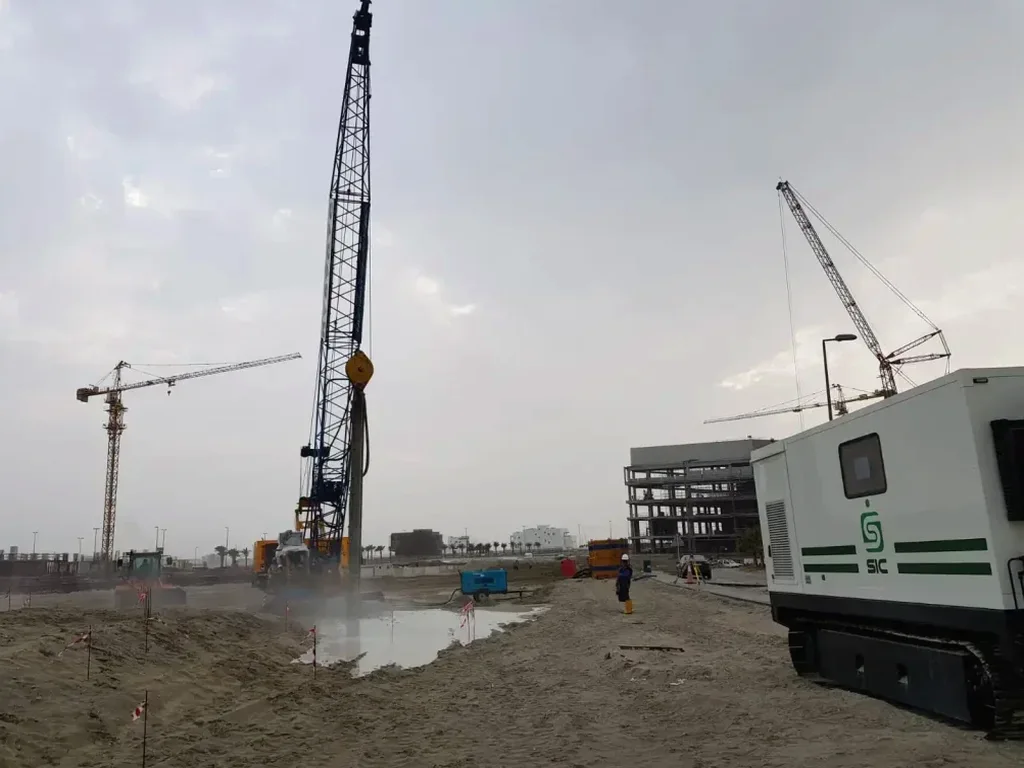
The most expensive mistake we see in Coquitlam is cutting a footing into undisturbed native till and assuming the whole site is just as solid. Thirty feet away there is a pocket of Fraser River Sand or uncompacted fill from the 1990s that nobody caught during the initial site investigation—and that is where the differential settlement starts. Vibrocompaction design fixes this before concrete goes in. We prepare site-specific treatment grids, target relative density above 70%, and specify the energy input required to reach it. For sites near the Coquitlam River or along the Lougheed Highway corridor, we often tie the design to a CPT test program: pre-treatment soundings to map the loose zones, post-treatment soundings to validate the improvement. The design package includes probe spacing, depth of treatment, backfill gradation, and vibration frequency ranges compatible with the vibroflot rigs available in the Lower Mainland.
A vibrocompaction grid designed without a pre-treatment CPT is just guesswork—and guesswork costs more than the investigation ever would.
Quick answers
How much does vibrocompaction design cost in Coquitlam?
What soil conditions in Coquitlam are suitable for vibrocompaction?
Clean to slightly silty sands with less than 12–15% fines passing the #200 sieve respond best. Coquitlam sites with Fraser River Sand, glaciofluvial deposits, or clean granular fill are good candidates. If the fines content is higher, we assess whether stone columns or dynamic replacement would be more effective before committing to a vibrocompaction design.
How do you verify that the compaction worked?
We specify a pre-treatment CPT baseline and a post-treatment CPT program on the same grid points. We compare tip resistance and sleeve friction at each depth increment. A relative density gain of 15 to 30 percentage points is typical. For critical structures we add crosshole shear wave velocity measurements to confirm stiffness improvement.
How close to existing buildings can vibrocompaction be used?
We design reduced-energy parameters for points within 15 meters of existing structures. By lowering the eccentric weight and extending the dwell time we keep peak particle velocity under 12 mm/s, which protects foundation walls and buried utilities. For distances under 5 meters we usually recommend switching to a low-vibration alternative such as stone columns.
What is the typical turnaround time for a vibrocompaction design?
For a standard industrial or commercial site in Coquitlam we deliver the design package within 8 to 12 business days after receiving the pre-treatment CPT data. Larger sites with multiple treatment zones or liquefaction analysis add 3 to 5 days. We can accommodate faster schedules when the drilling contractor is already mobilized.