← Home · Underground Excavations

Geotechnical Design of Deep Excavations in Coquitlam: Managing Complex Urban Sites

Together, we solve the challenges of tomorrow.

LEARN MORE →

Coquitlam's landscape, carved by the Fraser River and framed by the Coast Mountains, presents a unique set of challenges for any contractor going deep. You encounter dense glacial till and the highly variable Advance deposits, a legacy of the last ice age that makes every block different. The persistent rainfall—over 1,800 millimeters annually on the slopes—feeds a high groundwater table that doesn't just sit; it flows through permeable layers, creating real hydrostatic pressure against shoring walls. In our experience, relying on a generic design here is a direct path to costly delays. A proper geotechnical investigation with test pits is the first step to map the soil variability before we even begin the shoring analysis, because what you cannot see underground will always dictate the schedule above ground.

In Coquitlam's glacial soils, managing groundwater drawdown is just as critical as calculating the steel section modulus for your soldier piles.
Methodology and scope

The technical backbone of a safe excavation in this city starts with the right modeling software, and we lean heavily on finite element analysis platforms like PLAXIS 2D and 3D, calibrated with site-specific data. We don't just input textbook values; we pull direct parameters from local lab tests on undisturbed Shelby tube samples to define the Mohr-Coulomb failure envelope for the glacial till. This is critical because the till's high silt and clay matrix can exhibit significant strain-softening behavior. The design must explicitly calculate cantilever moments and anchor bond lengths, accounting for the proximity of adjacent footings. Where surcharge loads from neighboring buildings threaten stability, we often integrate a pre-construction inclinometer monitoring plan to verify the wall deflection predictions against real-world movements, allowing us to fine-tune the berm geometry on the fly.
Geotechnical Design of Deep Excavations in Coquitlam: Managing Complex Urban Sites
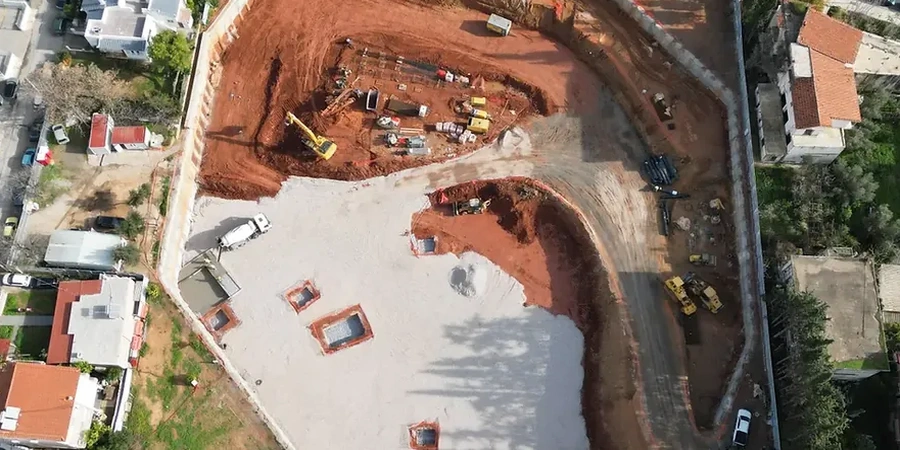
Technical reference image — Coquitlam

Local considerations

A few years back, a developer near the Coquitlam Centre area planned a three-level underground parkade. The initial shoring design assumed a homogeneous stiff clay, but the excavation hit a buried channel of loose, saturated sand at the six-meter mark. The inflow was instant, eroding material from under the adjacent roadway within hours. It was a stark reminder that the Advance depositional environment here is chaotic. The biggest risk we see time and again is basal heave in deep cuts through soft clay layers, which can undermine the entire floor slab if not countered with a solid strutting system or ground improvement. Ignoring the horizontal earth pressures from the nearby slope creep, common on the hillsides north of Lougheed Highway, can also induce a progressive wall failure that no amount of waler reinforcement can stop once it starts moving.

Need a geotechnical assessment?

Reply within 24h.

Email: contact@geotechnicalengineering.vip

Technical data

ParameterTypical value
Design StandardNBCC 2020, CAN/CSA-S6-19
Soil Condition FocusGlacial Till, Advance Deposits
Typical Excavation Depth8 m to 25 m for urban towers
Shoring Types AnalyzedSoldier pile & lagging, secant piles, diaphragm walls
Analysis MethodFinite Element (FEM), Limit Equilibrium (LEM)
Groundwater ControlDewatering system design, cut-off wall assessment
Seismic ConsiderationsGSC Seismic Hazard Model for crustal and subcrustal events

Associated technical services

01

Shoring Wall Design

Structural analysis of soldier pile, secant, and diaphragm walls using beam-on-elastic-foundation and FEM methods to resist lateral earth pressures.

02

Tieback Anchor Design

Calculation of unbonded and bonded lengths for grouted anchors, verified against empirical pull-out capacity data from local till formations.

03

Dewatering & Cut-off Systems

Design of wellpoint systems and assessment of jet grout cut-off walls to manage the high perched water tables common in the region.

04

3D Excavation Sequencing

Finite element modeling to analyze corner effects and staged excavation impacts on sensitive adjacent structures like the SkyTrain guideway.

Applicable standards

NBCC 2020 (National Building Code of Canada), CAN/CSA S6-19 (Canadian Highway Bridge Design Code), ASTM D7181 (Drained Triaxial Compression Test for Soils)

Quick answers

What specific soil conditions in Coquitlam most affect deep excavation design?

The dominant factor is the glacial geology. We deal with a complex mix of lodgment till, glaciofluvial sands, and glaciolacustrine silts. The till is typically dense and stable but contains cobbles and boulders that complicate piling. The interbedded sand and silt layers, however, are the real challenge because they act as confined aquifers. This means we have to design for higher hydrostatic pressures and potential piping risks at the base of the cut, a scenario that doesn't appear in a simple textbook analysis.

How do you ensure a deep excavation won't damage the SkyTrain infrastructure nearby?

For any project within the SkyTrain's zone of influence, we develop a detailed impact assessment based on TransLink's strict displacement criteria—often limiting movements to just a few millimeters. We build a calibrated 3D PLAXIS model that simulates the staged excavation and the dynamic loading from the trains. This model is then validated with a comprehensive vibration and settlement monitoring program, using robotic total stations and in-ground inclinometers to provide real-time feedback and trigger action levels if movements approach the threshold.

What is the typical cost range for a geotechnical design of a deep excavation in Coquitlam?

Location and service area

We serve projects across Coquitlam and surrounding areas.

View larger map