← Home · Laboratory

Proctor Compaction Testing in Coquitlam – Standard & Modified

Together, we solve the challenges of tomorrow.

LEARN MORE →

The contrast between Coquitlam’s dense glacial till along the slopes of Westwood Plateau and the softer alluvial deposits near the Fraser River makes moisture-density relationships a decisive factor on any earthwork project here. A subgrade that compacts beautifully at Austin Heights might need completely different moisture conditioning just two kilometers south in Maillardville. We run both Standard and Modified Proctor tests under ASTM D698 and D1557 to establish target dry density and optimum moisture content before a single compactor hits the ground. The data feeds directly into field density checks with a nuclear gauge or sand cone and lets the grading contractor dial in lift thickness and roller passes with confidence. In a city where annual precipitation averages over 1,800 mm, locking in the right moisture window is not a detail—it is the difference between a subgrade that holds and one that softens after the first rainy season.

A Proctor number without the moisture-density curve tells you nothing—you need the whole relationship to manage compaction in Coquitlam’s rain-soaked construction season.
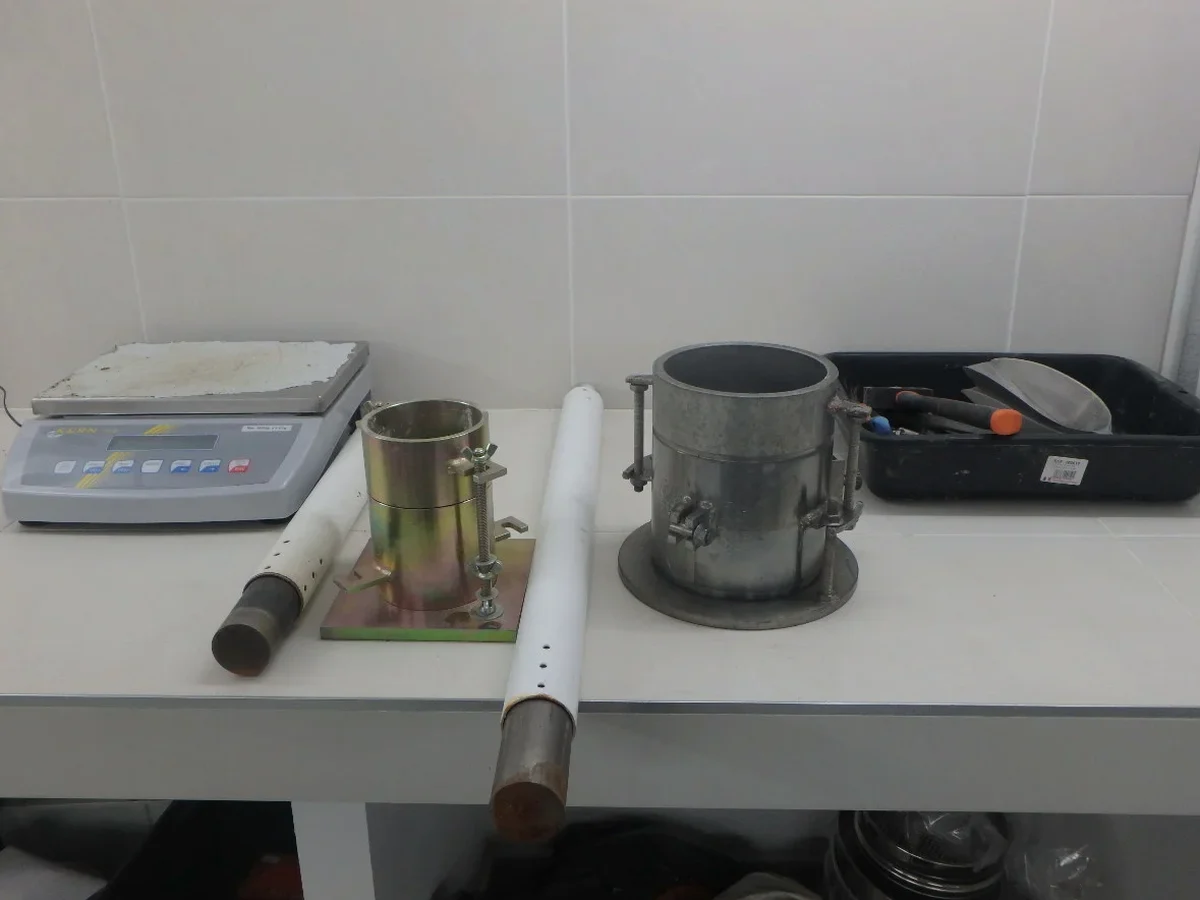
Methodology and scope

The 2020 National Building Code of Canada references ASTM D698 and D1557 as the baseline for engineered fill acceptance, and most municipalities in Metro Vancouver embed those same standards in their subdivision and building permit requirements. Coquitlam’s geology adds a twist: the Vashon till that caps much of the upland areas often contains a mix of sand, silt, and gravel that responds sharply to small changes in water content. A Standard Proctor test (12,400 ft-lbf/ft³ compactive effort) typically suits residential pad preparation and landscape berms, while the Modified Proctor (56,000 ft-lbf/ft³) applies to heavy-duty pavement sections and structural fill beneath mat foundations. For projects where the natural till transitions into softer glaciomarine silts, we often pair the Proctor curve with grain-size analysis to flag gradations that are inherently moisture-sensitive. Our lab processes samples within 48 hours of collection, and we report the full compaction curve, ZAV line, and percent saturation contours so the site engineer can set realistic field targets instead of chasing an unachievable number.
Proctor Compaction Testing in Coquitlam – Standard & Modified
Technical reference image — Coquitlam

Local considerations

A 14-storey residential project on Glen Drive a few years back ran into trouble because the imported structural fill was placed at moisture contents 4% above optimum, relying on a Proctor curve from a borrow source that had changed mid-project. The floor slabs started showing differential movement within six months. Coquitlam’s wet season runs from October through April, and fill placed even slightly wet of optimum during that window can trap pore pressures that bleed out slowly in the silty tills common on Burke Mountain. The risk compounds when the subgrade freezes in January and thaws in March, creating a crust that feels firm to the roller operator while the underlying lift stays spongy. We recommend a new Proctor curve every 1,500 cubic metres of fill or whenever the borrow source changes—whichever comes first—and at least one field density correlation per lift using the same lab that ran the Proctor. That closes the loop between the lab curve and what the nuclear gauge or sand cone reads on site.

Need a geotechnical assessment?

Reply within 24h.

Email: contact@geotechnicalengineering.vip

Technical data

ParameterTypical value
Test standards performedASTM D698 (Standard) and ASTM D1557 (Modified)
Compactive effort (Standard)12,400 ft-lbf/ft³ (600 kN-m/m³)
Compactive effort (Modified)56,000 ft-lbf/ft³ (2,700 kN-m/m³)
Mold size4-inch (101.6 mm) and 6-inch (152.4 mm) diameter
Method selectionA, B, or C based on percent retained on No. 4 and ¾-inch sieves
Typical reporting turnaround2 working days from sample receipt
Oversize correctionApplied per ASTM D4718 when +No. 4 exceeds 5%

Associated technical services

01

Standard Proctor (ASTM D698)

Appropriate for residential slabs, landscape fill, utility trench backfill, and low-rise building pads. We test both 4-inch and 6-inch molds depending on maximum particle size and report optimum moisture content, maximum dry density, and the full compaction curve with ZAV reference.

02

Modified Proctor (ASTM D1557)

Specified for arterial road subgrades, heavy industrial floors, and structural fill supporting mat or pile foundations. The higher compactive effort simulates modern vibratory rollers and heavy compaction equipment. Oversize correction per ASTM D4718 is applied when granular fractions exceed 5% retained on the No. 4 sieve.

Applicable standards

ASTM D698 – Standard Test Methods for Laboratory Compaction Characteristics of Soil Using Standard Effort, ASTM D1557 – Standard Test Methods for Laboratory Compaction Characteristics of Soil Using Modified Effort, ASTM D4718 – Standard Practice for Correction of Unit Weight and Water Content for Soils Containing Oversize Particles, CSA A23.3 – Concrete structures (referenced for foundation interface with compacted fill)

Quick answers

How much does a Proctor test cost in Coquitlam?
Which Proctor method do I need for a townhouse development on Burke Mountain?

For townhouse pads on Burke Mountain, the Standard Proctor (ASTM D698) generally governs because the loading is relatively light and settlement tolerance is moderate. However, if the access road is being built to municipal arterial standards, the City of Coquitlam’s engineering department will likely require Modified Proctor values for the road subgrade and any structural fill beneath retaining walls. We always recommend checking the geotechnical specification in the project’s soils report before sampling.

How long does the lab take to deliver Proctor results?

Our standard turnaround is two working days from sample receipt. Same-day or next-day results are available for urgent pours or compaction hold points, as long as the sample arrives before 10:00 AM and we receive advance notice. The report includes the full moisture-density curve, optimum moisture content, maximum dry density, ZAV line, and percent saturation contours.

Location and service area

We serve projects across Coquitlam and surrounding areas.

View larger map