← Home · Laboratory

Triaxial Testing in Coquitlam: Shear Strength Parameters for Foundation Design

Together, we solve the challenges of tomorrow.

LEARN MORE →

Coquitlam’s transformation from a mill town on the Fraser River into a dense urban node for Metro Vancouver has placed heavy demands on its underlying geology. The city spreads across glacially over-steepened slopes, alluvial fans at the foot of the Coast Mountains, and pockets of compressible silts near the Coquitlam River, creating a patchwork of geotechnical challenges that simple index tests cannot resolve. For deep excavations along Lougheed Highway or multi-storey mixed-use blocks on North Road, determining the true shear strength of foundation soils requires a triaxial test that replicates in-situ confining pressures and pore-water conditions. Our laboratory, operating under an ISO 17025-accredited quality system, processes undisturbed Shelby tube samples from Coquitlam sites within 48 hours of extraction to minimize moisture loss and sample disturbance before shearing begins.

A CU triaxial test with pore pressure measurement reveals the effective stress path that index tests can only guess at, especially in Coquitlam’s over-consolidated glacial silts.
Methodology and scope

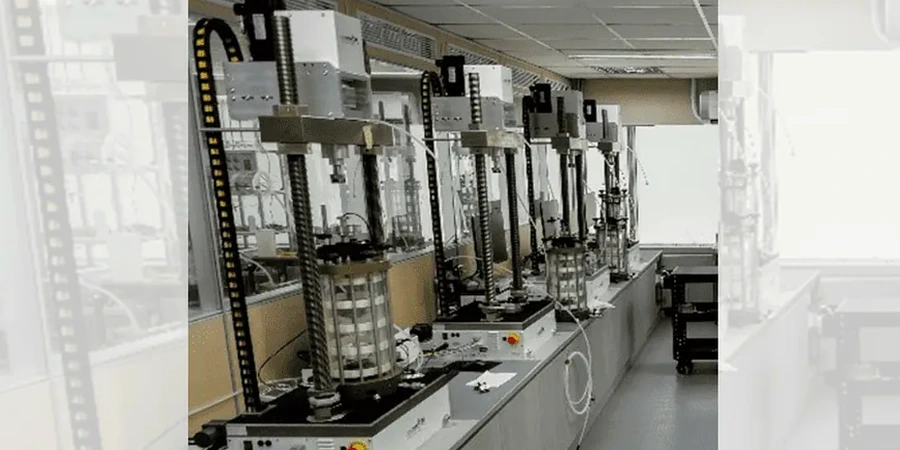
A recent 18-storey residential project on Austin Avenue encountered dense glacial till overlying a slick, pre-sheared clay seam at 14 metres depth, a legacy of the Vashon glaciation. Standard penetration data alone could not quantify the anisotropic strength reduction along that failure plane, so the design team commissioned a suite of consolidated-undrained triaxial tests with pore pressure measurement. The stage-wise loading protocol, following ASTM D4767, allowed the structural engineer to model the clay’s strain-softening behaviour in PLAXIS and adjust the pile group factor accordingly. When a project involves such complex stratigraphy, we often recommend pairing the triaxial program with an SPT drilling campaign to map the spatial continuity of weak horizons, and with slope stability analysis if the excavation faces a cut exceeding 4 metres. The triaxial cell’s ability to control drainage and measure excess pore pressure makes it indispensable for defining the effective stress path that governs long-term stability in Coquitlam’s over-consolidated silts.
Triaxial Testing in Coquitlam: Shear Strength Parameters for Foundation Design
Technical reference image — Coquitlam

Local considerations

Coquitlam sits within a high seismic hazard zone under the 2020 National Building Code of Canada, with a 2% in 50-year spectral acceleration exceeding 0.75g in some neighbourhoods north of Como Lake. The cyclic loading induced by a shallow crustal or deep subduction earthquake generates rapid pore pressure accumulation in saturated silts and fine sands of the Capilano Sediments unit, which underlies much of the city centre. A total-stress UU triaxial test cannot capture this degradation, but a CU test with cyclic post-peak unloading can provide the modulus reduction curves needed for a site-specific liquefaction assessment. Ignoring the strain-softening potential of these glaciolacustrine deposits, which lose up to 60% of their peak strength at just 5% axial strain, leads to unconservative bearing capacity calculations and potential differential settlement of shallow footings under seismic demand.

Need a geotechnical assessment?

Reply within 24h.

Email: contact@geotechnicalengineering.vip

Technical data

ParameterTypical value
Test types offeredUU, CU, CD, multi-stage CU
Applicable standardsASTM D4767-11, D2850-15, D7181-20
Specimen diameter35 mm to 100 mm (Shelby tube and block samples)
Maximum cell pressure2,000 kPa (saturated and unsaturated)
Pore pressure measurementMid-plane electronic transducer, back-pressure saturation
Data output per stagec’, φ’, c_u, E_50, stress-strain curves, p-q plot
Typical shearing rate (CU)0.01–0.05 mm/min for silts and clays
B-value saturation target≥ 0.95 per ASTM D4767

Associated technical services

01

Consolidated-Undrained (CU) Triaxial with Pore Pressure

The standard for effective stress analysis in Coquitlam’s low-permeability silts and clays. We saturate specimens to a Skempton B-value of at least 0.95, consolidate to estimated in-situ stress, and shear at a rate slow enough to permit pore pressure equalization. Results deliver c’ and φ’ for long-term slope and excavation design.

02

Unconsolidated-Undrained (UU) Triaxial

Used for rapid assessment of undrained shear strength in saturated cohesive soils during the construction phase. This test provides a conservative c_u for short-term bearing capacity checks before pore pressures can dissipate, and is often run on the same Shelby tube samples used for Atterberg limits and unconfined compression screening.

03

Multi-Stage CU with Cyclic Post-Peak

A single specimen is sheared in three or more confinement stages, with unloading-reloading loops after peak strength to quantify modulus degradation. This protocol is particularly valuable for time-history analysis of deep excavations and pile group response under the NBCC seismic envelope for Coquitlam.

Applicable standards

ASTM D4767-11: Standard Test Method for Consolidated Undrained Triaxial Compression Test for Cohesive Soils, ASTM D2850-15: Standard Test Method for Unconsolidated-Undrained Triaxial Compression Test on Cohesive Soils, ASTM D7181-20: Method for Consolidated Drained Triaxial Compression Test for Soils, NBCC 2020 seismic provisions referencing site-specific shear modulus and damping, CSA A23.3-19 for concrete foundation elements requiring soil-structure interaction parameters

Quick answers

How much does a triaxial test program cost for a Coquitlam site?
What distinguishes a CU from a UU triaxial test?

A consolidated-undrained (CU) test includes a saturation and consolidation phase before shearing, plus pore pressure measurement during shear, which permits separation of total stress into effective stress components (c’, φ’). An unconsolidated-undrained (UU) test skips the consolidation phase and reports only total-stress undrained shear strength (c_u), making it faster but limited to short-term stability checks during construction.

How do you select the appropriate shearing rate for Coquitlam’s silts?

We calculate the shearing rate based on the coefficient of consolidation from the consolidation phase, following ASTM D4767. For Coquitlam’s low-plasticity glacial silts, which typically show a cv in the range of 2–8 m²/year, this translates to a shearing rate of approximately 0.01–0.04 mm/min to ensure full pore pressure equalization across the specimen mid-height during a CU test.

Location and service area

We serve projects across Coquitlam and surrounding areas.

View larger map